
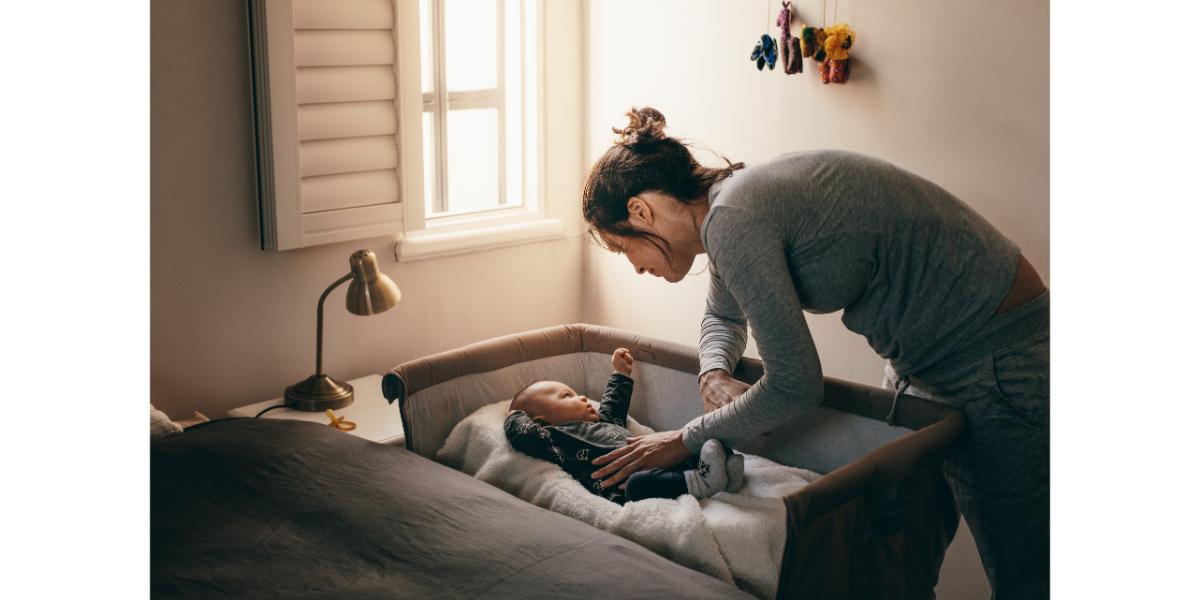
Every parent asks some version of this question. When will my baby sleep through the night? The honest answer is that it depends on the child. The age ranges below are rough guides, not targets. Most healthy infants start stringing together longer nighttime stretches somewhere between three and six months of age, and a smaller group reliably sleeps close to twelve hours by the second half of the first year. What matters is that your baby is growing well, feeding effectively during the day, and sleeping in a safe environment.
A Realistic Timeline
Every baby follows a slightly different path. Use these ranges as general expectations, not as a scorecard.
- 0 to 3 months: night feeds every two to four hours are expected. Brief stretches of four to six hours may appear toward the end of this window.
- 3 to 6 months: many babies can sleep five to eight hours at a time, and some families will see longer stretches developing.
- 6 to 9 months: many healthy full-term infants no longer need a night feed and can sleep stretches of eight or more hours. Brief wakings followed by self-settling are common and normal.
- 9 to 12 months and beyond: ten to twelve hours of overnight sleep becomes typical, though teething and illness still interrupt sleep from time to time.
- Premature infants and babies with medical concerns often reach these milestones later. That is expected, not a problem.
Brief nighttime wakings are normal at every age, including for adults. The question is not whether your baby wakes, but whether they can return to sleep without much help.
Safe Sleep Comes First
Before any conversation about sleep training or scheduling, the sleep environment itself matters most. These recommendations come directly from the American Academy of Pediatrics and are the single most important thing you can do to reduce the risk of SIDS and other sleep-related infant deaths.
- Alone, on the Back, in a Crib. The ABCs of safe sleep.
- Firm, flat mattress with a fitted sheet and nothing else in the crib.
- No pillows, blankets, bumpers, or soft toys during the first year.
- Room-share without bed-sharing for at least the first six months, ideally the first year.
- Avoid overheating. Dress your baby in lightweight clothing appropriate for the room temperature, do not cover the head during sleep, and do not overbundle.
- Offer a pacifier at sleep once breastfeeding is well established, typically around 3 to 4 weeks. This is protective against SIDS. You do not need to reinsert it once your baby has fallen asleep.
- Keep the home smoke-free.
- Do not use inclined sleep surfaces such as the Rock ‘n Play or similar inclined seats. These were federally banned in 2022 because of suffocation risk.
- Do not use weighted blankets, weighted swaddles, or weighted sleep sacks. AAP advises against weighted products in infants.
- Do not use in-bed sleepers or other attachment products marketed for safe co-sleeping. They have not been demonstrated to be safe.
- Car seats, strollers, swings, bouncers, and infant carriers are not for routine sleep. If your baby falls asleep in one, move them to a flat sleep surface as soon as practical.
- Stop swaddling at the first signs that your baby is starting to roll, usually around three to four months.
- Once your baby can roll both ways on their own, you can leave them in the position they choose during sleep, but always place them on their back to start.
- Keeping vaccines up to date is also protective against SIDS.
- Home cardiorespiratory monitors and consumer “smart” sleep products (such as Owlet) do not replace safe sleep practices. AAP does not recommend them as a substitute.
- Breastfeeding, when possible, is also protective against SIDS.
Signs Your Baby Is Getting Close
- Already sleeping five- to six-hour stretches at night.
- Feeding efficiently during the day and gaining weight appropriately.
- Starting to self-settle: sucking on fingers, rolling to a comfortable position, or murmuring quietly back to sleep.
- Predictable daytime naps and feeding windows.
You may have heard that a baby needs to weigh fifteen or sixteen pounds before they can sleep through the night. That is an old rule of thumb passed around between parents, not something supported by research. Whether a baby is ready to sleep longer stretches depends on how their brain and nervous system are maturing, not on what the scale says.
Why Some Babies Take Longer
- Prematurity.
- Feeding discomfort or gas.
- Periods of increased feeding demand, which come and go through the first six months.
- Teething.
- Sleep regressions, particularly the well-known four-month regression, when sleep architecture matures.
- Less common medical issues, including airway problems noticed during sleep.
What You Can Do
- Build a predictable twenty- to thirty-minute bedtime routine: bath or wipe-down, clean diaper, feeding, a quiet story or song, lights out.
- Many families find it helpful to put their baby down drowsy but awake, so the baby learns to associate the crib with falling asleep.
- Keep the room dark and use white noise at a safe volume to mask household sounds.
- For older infants who still wake for feeds and are gaining weight well, gentle night weaning can help. Gradually reduce the volume or length of night feeds while increasing daytime calories.
- Exclusively breastfed infants commonly feed at night longer than their formula-fed peers. That pattern is normal and is not a problem as long as growth is on track.
Common Sleep Disruptors
- Illness, including colds, ear infections, and fever.
- Teething pain.
- Developmental leaps such as rolling, crawling, and pulling to stand.
- Travel and schedule changes.
- Caffeine in a breastfeeding mother’s diet, which a minority of babies seem sensitive to.
FAQ
Is my baby too young to sleep twelve hours?
If your baby is younger than three months, yes. Newborns need regular night feeds for growth and to help maintain milk supply in breastfeeding mothers.
What if my baby still wakes up hungry?
That is a normal phase. Night weaning should be gradual. If your baby is growing well and we agree it is time, you can begin to reduce night feeds slowly.
Can I sleep train during an illness?
No. Focus on comfort and hydration until your child is well. Then return to your usual routines.
Should I try a dream feed?
Some families find that a late-evening feed while the baby is still drowsy extends the first stretch of sleep. It works for some families and not others. There is no wrong answer.
When to Call Us
- Your baby is older than nine months and waking multiple times a night despite no illness or teething.
- Snoring, pauses in breathing, or noisy, labored breathing during sleep. These can signal a problem with the airway that we will want to evaluate.
- Vomiting, fewer wet diapers, dry lips, or other signs of dehydration.
- Fever, persistent cough, or a rash.
- Sudden behavioral changes that last more than a few days.
Bottom Line
Sleeping from 7pm to 7am is not a developmental finish line. Some babies get there at five months and some at eleven months, and both are healthy. Keep the sleep environment safe, the bedtime routine predictable, and your expectations flexible. Over time your child will learn that nighttime is for sleeping, and the household will follow.
Questions about your child’s sleep or any other concern? Call ELP at (727) 372-6760 or schedule online. Stay healthy my friends.
Sources
- American Academy of Pediatrics, HealthyChildren.org: “Getting Your Baby to Sleep” and “Safe Sleep: Recommendations.”
- AAP Policy Statement: “Sleep-Related Infant Deaths: Updated 2022 Recommendations for Reducing Infant Deaths in the Sleep Environment.”
- Academy of Breastfeeding Medicine, Clinical Protocol #6 on bed-sharing and breastfeeding.
- Seattle Children’s / Schmitt Pediatric Guidelines: Sleep concerns in infants.