Diaper rash is almost universal at some point in the first two years. Most cases are irritant contact dermatitis and respond to a simple routine of changing more often, cleaning gently, and protecting the skin with a thick barrier cream. A smaller number of cases involve yeast, bacteria, or an underlying condition and need a different approach. This handout covers how to tell them apart, how to treat each one, and when to call us.
Key Takeaways
- Most diaper rash is irritant contact dermatitis from prolonged skin contact with urine and stool.
- Change, clean, and protect: change diapers promptly, clean with warm water and a soft cloth, and apply a thick zinc oxide or petroleum-based barrier cream at every change.
- Bright red, beefy rash with small satellite dots that extends into the skin folds usually signals yeast (Candida) and often needs an antifungal cream.
- Call us for rash that lasts more than 3 days despite good home care, any blisters or weeping, bright red beefy rash, fever, or a sick-looking baby.
Types of Diaper Rash
Irritant contact dermatitis.
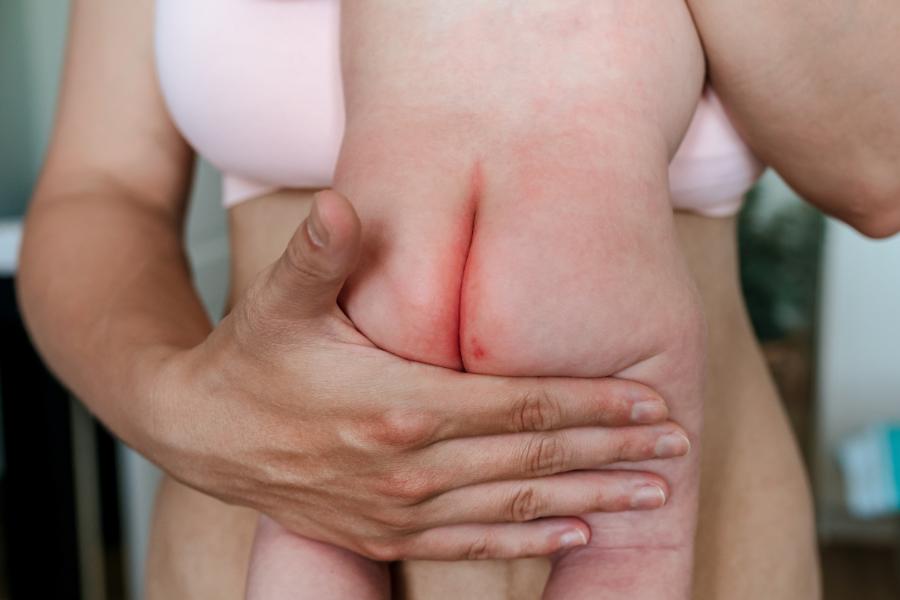
By far the most common. Pink to red skin on the convex surfaces (buttocks, upper thighs, lower abdomen), typically sparing the deep skin folds. Caused by prolonged contact with urine and stool and friction from the diaper.
Candida (yeast) dermatitis.
Beefy-red skin with sharply defined edges, small red satellite bumps, and involvement of the skin folds. Often appears or worsens after diarrhea, antibiotics, or prolonged moisture. Usually needs a topical antifungal (such as nystatin or clotrimazole) in addition to barrier care.
Bacterial.
Two main patterns. (1) Perianal strep, a bright red sharply demarcated rash around the anus, sometimes with painful bowel movements or blood-streaked stool. This usually needs a course of oral antibiotics. (2) Staphylococcal bullous impetigo, with honey-crusted lesions or flaccid blisters with pus, which usually needs an oral antibiotic targeting staph.
Allergic contact dermatitis.
Red, sometimes blistered rash that follows the exact pattern of the product in contact, for example the waistband of a particular diaper or the area under a wipe. The two most common wipe culprits are methylisothiazolinone (a preservative) and fragrance. Switching to a fragrance-free, preservative-light brand often helps.
Seborrheic dermatitis or eczema.
Rash that extends beyond the diaper area, involves the scalp, ears, or skin folds, or is markedly itchy may reflect an underlying skin condition rather than a pure diaper issue.
Prevention
- Change diapers every 1 to 2 hours during waking hours, and any time the diaper is soiled. A soiled diaper left on for an extended period is the single most important risk factor.
- Clean with warm water and a soft cloth, or with a gentle, fragrance-free, alcohol-free wipe.
- Apply a thick layer of a zinc oxide or petroleum-based barrier cream at every change, especially during times of increased stool frequency.
- Pat dry, do not rub. Allow the skin to air dry briefly if possible.
- Avoid tight-fitting diapers or clothing over the diaper area.
- 10 to 15 minutes of diaper-free air time on a waterproof pad, 2 to 3 times a day. More if the rash is active.
Florida Considerations
Heat and humidity prolong skin wetness and speed up diaper-area breakdown. After pool, beach, or lake time, rinse your baby off, dry the diaper area thoroughly, and reapply barrier cream before putting on a fresh diaper. Sand under a swim diaper is mechanically irritating. Brush it off before redressing.
Treatment at Home
- Increase the frequency of diaper changes, day and night if needed.
- Clean gently. Warm water is enough. Skip fragranced or alcohol-containing wipes while the skin is inflamed.
- Apply a thick layer of zinc oxide or petroleum barrier at every change. Do not wipe it all off. Reapply over any residue.
- If a yeast rash is likely (beefy-red, skin-fold involvement, satellite dots), add an over-the-counter antifungal such as clotrimazole twice daily under the barrier cream. Continue twice daily for at least 7 days, and 2 to 3 days past clearing, to prevent rebound. If it has not improved within 3 days, call us. Prescription-strength nystatin is an option. If your child has just finished a course of antibiotics, expect yeast and consider starting clotrimazole at the first sign of a beefy red rash with satellite dots.
- Avoid topical steroids unless we have specifically recommended them. Over-the-counter hydrocortisone can be appropriate for short courses in specific situations but is not a routine diaper-rash treatment.
- Avoid combination antifungal-steroid creams such as nystatin-triamcinolone or clotrimazole-betamethasone in the diaper area. The steroid component under the occlusion of a diaper can thin the skin and cause other problems.
When to Call Us
- Rash that has not improved in 3 days of good home care.
- Grouped small blisters or punched-out sores anywhere in the diaper area, especially with fever or in a young infant. These can suggest herpes simplex and need same-day evaluation.
- Rash with blisters, open sores, weeping, pus, or crusting.
- Bright red, beefy rash involving the skin folds, especially after recent antibiotics or diarrhea.
- Rash that spreads outside the diaper area.
- Bright red sharply defined rash around the anus, or blood-streaked stool (suggests perianal strep).
- Rash with fever, poor feeding, or a sick-looking baby.
- Any rash that is painful or interfering with sleep or feeding.
- Recurrent rashes despite a good routine. Repeat yeast infections sometimes respond to oral treatment or a short oral antifungal.
A Few Common Questions
Cloth or disposable?
Either is fine when diapers are changed frequently. Risk is less about the material than about how quickly a wet or soiled diaper is removed.
Are baby powders helpful?
No. Talc and cornstarch powders are not recommended. Talc carries inhalation risk, and powders in general can irritate the airway and provide no protective benefit.
Can diet affect diaper rash?
Yes. Introducing solids changes stool composition and can temporarily irritate the skin. Acidic foods (citrus, tomato) and new foods with higher stool output are common culprits. Breastfed infants tend to have less diaper rash overall because breastfed stool is less alkaline and less irritating to the skin.
Bottom Line
Most diaper rash gets better within a few days of prompt changes, gentle cleaning, and a generous barrier cream. Rashes that do not follow that script are the ones we want to see.
Call ELP at (727) 372-6760 or schedule online. Stay healthy my friends.
Sources
- American Academy of Pediatrics, HealthyChildren.org: articles on diaper rash.
- AAP Clinical Report and Section on Dermatology guidance on diaper dermatitis.
- AAP Red Book, current edition: perianal Group A streptococcal disease and cutaneous candidiasis.
- Seattle Children’s / Schmitt Pediatric Guidelines: Diaper Rash.